
MORI–FUSILLO, THE DEBATE: SOVEREIGNTY, MONEY, THE STATE, BITCOIN
17 November 2023 · difendersiora
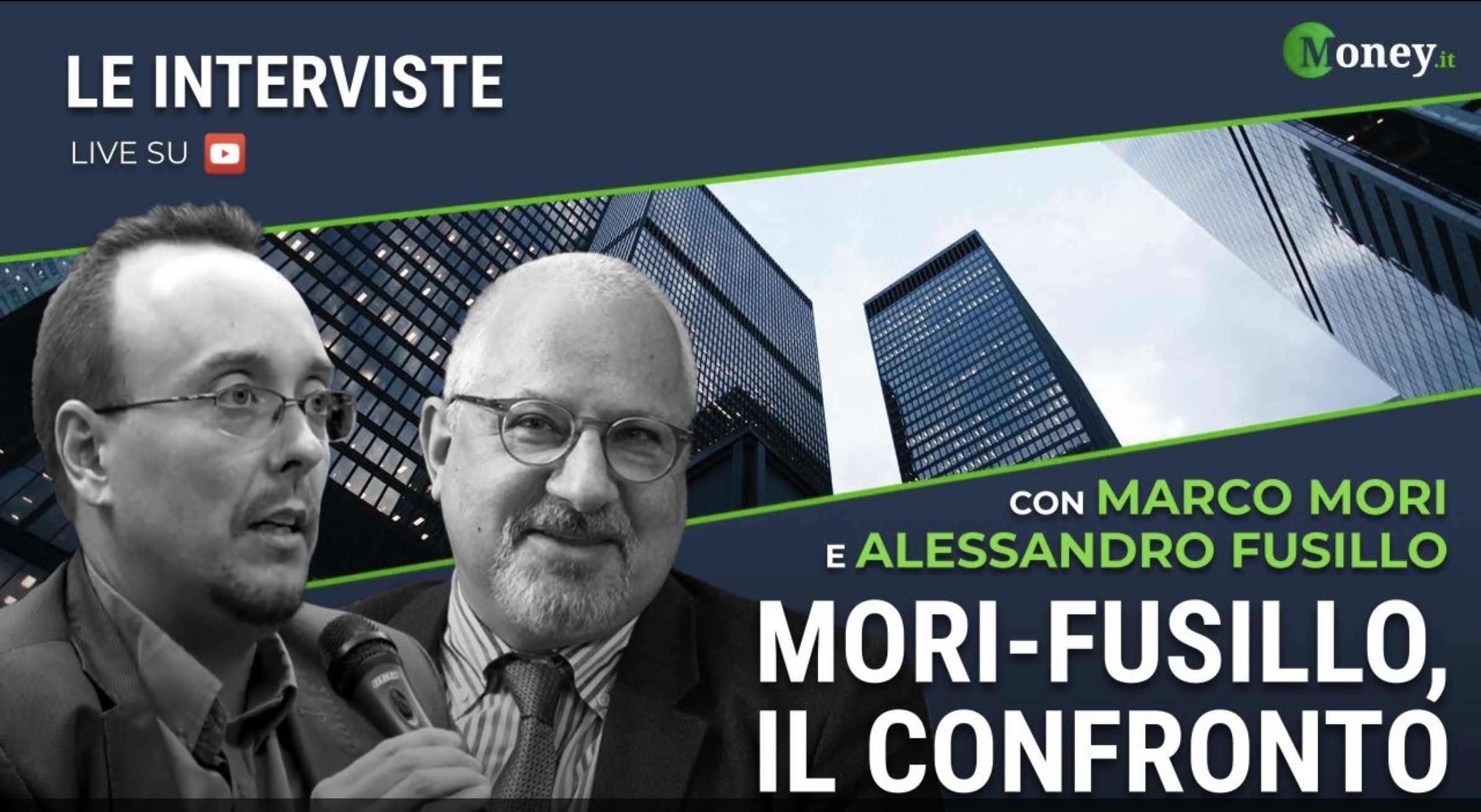
What is money, and who should decide how much of it to create: the state and its central banks, or consumers? Yesterday on Money.it, there was an interesting debate moderated by Fabio Frabetti between two diametrically opposed conceptions represented, respectively, by Marco Mori and Alessandro Fusillo.
Mori favours the restoration of monetary sovereignty by Italy in order to issue money out of thin air and eliminate unemployment through a public spending programme funded by fiat money. This is the very same situation we have today with quantitative easing, except that Mori would like to place the money-printing press in different hands. Following the ideas of Chartalism and Modern Monetary Theory—and in part of Keynes—Mori believes that wherever there is unemployment, there is room to create money out of thin air. These are old ideas belonging to mainstream economic thought that defend, perhaps unintentionally, the status quo.
Fusillo, like many libertarians, subscribes to the principles of the Austrian School (von Mises, Hayek, Rothbard, Hoppe) and believes that monetary sovereignty should not exist and that it is impossible to create wealth by printing pieces of paper (whether physical or electronic). Continuing to support fiat money is a gift to a financial system that wants us enslaved. Wealth stems from saving and the production of goods and services, not from the creation of money. In our system, money is the monopoly of a narrow group of central banks privately owned by major financial potentates (Rothschild, Rockefeller, Morgan, Warburg, etc.). By creating money out of thin air, central banks destroy the purchasing power of each and every one of us through a systematic transfer of wealth from the poor and middle classes to the richest. Whoever controls the money holds all the power: whoever commands all the means can dictate all the ends. To dismantle this system of power and make wealth accessible to all, it is necessary to eliminate the theft perpetrated through fiat currencies, not to distribute them.
Many believe that Italy's past wealth derived from printing the Lira, but this is an illusion. Italy was prosperous, as Milton Friedman pointed out, thanks to tax evasion and the fact that the rules were not observed. Italy once produced goods and services, certainly not by virtue of a parasitic public sector and even less so because politicians were printing Lire. Monetary inflation was not a help, but an obstacle.
A reversal of the trend cannot be achieved by transferring the money-printing press from central banks to states, because the perverse mechanism of inflation would remain. An increase in the money supply always and invariably entails a loss of purchasing power, even when the new money manages to tap idle resources and is not ostensibly reflected in a rise in the consumer price index. The way out is a decentralised currency, owned by those who use it, whose quantity cannot be influenced (there is no ideal or desirable quantity of money). The historical model of a non-inflationary currency was gold (not the gold standard, which allowed for significant manipulation by states and central banks). Today, the currency that mimics and improves upon the experience of gold is Bitcoin.
Bitcoin has no owner and cannot be created without incurring a cost; it is anonymous and immune to state confiscation. The path to freedom lies through the abolition of monetary sovereignty.
Here is the link to watch the video:
Further reading on Bitcoin:
S. Ammous, The Bitcoin Standard
S. Ammous, The Fiat Standard
https://shop.usemlab.com/combos/159-combo-il-fiat-standard-villaggio-bitcoin.html
.